
Do This Now
- 1 FL Studio for pattern-first beats. The Channel Rack and piano roll get a drum loop and a melody out of your head faster than anything else here.
- 2 Ableton Live for sample flipping and anything you will play live. Session view and warping are the reason, not the stock sounds.
- 3 Logic Pro if you are on a Mac and want the most stock content per dollar. USD 199.99 once, no editions to decode.
- 4 Logic Pro requires macOS 15.6 or later and Apple silicon, so on a Windows laptop the choice is FL Studio or Ableton.
- 5 Cubase is the deep MIDI editor of the group and the one least aimed at beat makers. Check Steinberg for current pricing before you commit.
- 6 Pick on workflow, not features. None of the three opens another's project files, so switching in a year costs you every unfinished session.
Watch the technique in action, then read on for the details.
Most of the FL Studio vs Ableton Live argument online is people defending whichever program they learned first. The useful version of the question is narrower: which one gets an idea out of your head and into a loop with the fewest clicks, and what do you actually own after you pay.
This is written for beat makers. Sample-based hip-hop, trap, drill, phonk, lo-fi, house and techno, on a laptop, probably with one screen and a cheap interface. If you are scoring film, the trade-offs below are the wrong ones for you.
One thing settles a lot of this before workflow comes up. Logic Pro requires macOS 15.6 or later and a Mac with Apple silicon, so on a Windows machine you are choosing between FL Studio and Ableton Live and nothing else.
What Actually Separates FL Studio, Ableton and Logic Pro
All three will finish a beat. The difference is what the main window wants you to do first, and that quietly shapes what you make.
FL Studio opens on a step sequencer and a pattern, so you tap in drums. Ableton Live opens on a grid of clips, so you audition and loop. Logic Pro opens on a timeline of tracks, so you think in arrangement from the first bar.
The friction nobody mentions is the exit cost. None of these three can open another one's project files, so a switch in twelve months means every unfinished session stays behind. Choose like you are signing a lease, not downloading a plugin.
- FL Studio 2026
- From $99, lifetime free updates
- Ableton Live 12 Intro
- USD 99
- Ableton Live 12 Standard
- USD 349
- Ableton Live 12 Suite
- USD 749
- Logic Pro
- USD 199.99 one-time
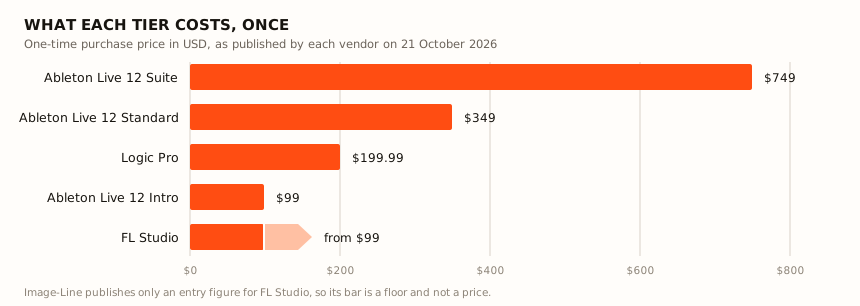
Logic Pro buys the whole program once. The Ableton figure depends entirely on which of three tiers you land on.
FL Studio vs Ableton: Step Sequencer Against Session View
FL Studio's Channel Rack is still the quickest route from silence to a drum loop. Each sound sits on its own row with a 16 step grid in front of it, and you can have a kick, snare and hat pattern playing in under a minute without opening a single editor.
Its piano roll is the real reason producers stay. Slides, ghost notes, per-note velocity and the chop and arpeggiate tools are all in one window, which is why 808 glides and fast hat rolls are less of a fight here than anywhere else. The trap beat guide assumes that kind of editor.
Ableton answers with Session view. Clips live in a grid, you launch them in combinations, and the version of the beat you keep is the one you heard rather than the one you planned. Warping is the other half of that: drop in any break or loop, set the markers, and it locks to your tempo without the pitch artefacts you get from a lazy stretch.
FL Studio's friction is the mixer. Channels are not routed to mixer inserts automatically, so the first time you try to bus your drums you find eight sounds stacked on insert one. Assign inserts as you go, which the first mix guide treats as step zero for a reason.
Ableton's friction is that Session view never asks you to finish. There is no always-visible step grid either, so programming hats means drawing them in the MIDI editor or playing them in. Loops are easy in Live and arrangements are a deliberate act.
Ableton vs Logic Pro: Warping Against Stock Content
Ableton Live vs Logic Pro is the comparison where price does most of the talking. Ableton Live 12 comes in three tiers and the gap between them is large: Intro gives you 16 audio and MIDI tracks, 8 instruments, 27 audio effects and 5+ GB of content, Standard opens that to unlimited tracks, 13 instruments, 42 audio effects, 38+ GB and the 14 MIDI tools, and Suite reaches 20 instruments, 58 audio effects and 71+ GB. Max for Live is Suite only.
Logic Pro is one purchase at USD 199.99 and there is nothing to decode. Sample Alchemy, Quick Sampler, Alchemy, Drum Machine Designer, Drum Synth, a Step Sequencer, Beat Breaker, Remix FX, ChromaVerb and Stem Splitter are all in the box, plus the Session Players for synth, piano, bass and drums. For a producer who wants to stop buying things, that is the strongest value per dollar of the three.
Where Logic does not catch up is warping. Ableton's handling of off-grid audio is still the reason people keep Live installed next to something else, and Logic's Smart Tempo is capable rather than surgical when a break refuses to sit on the grid.
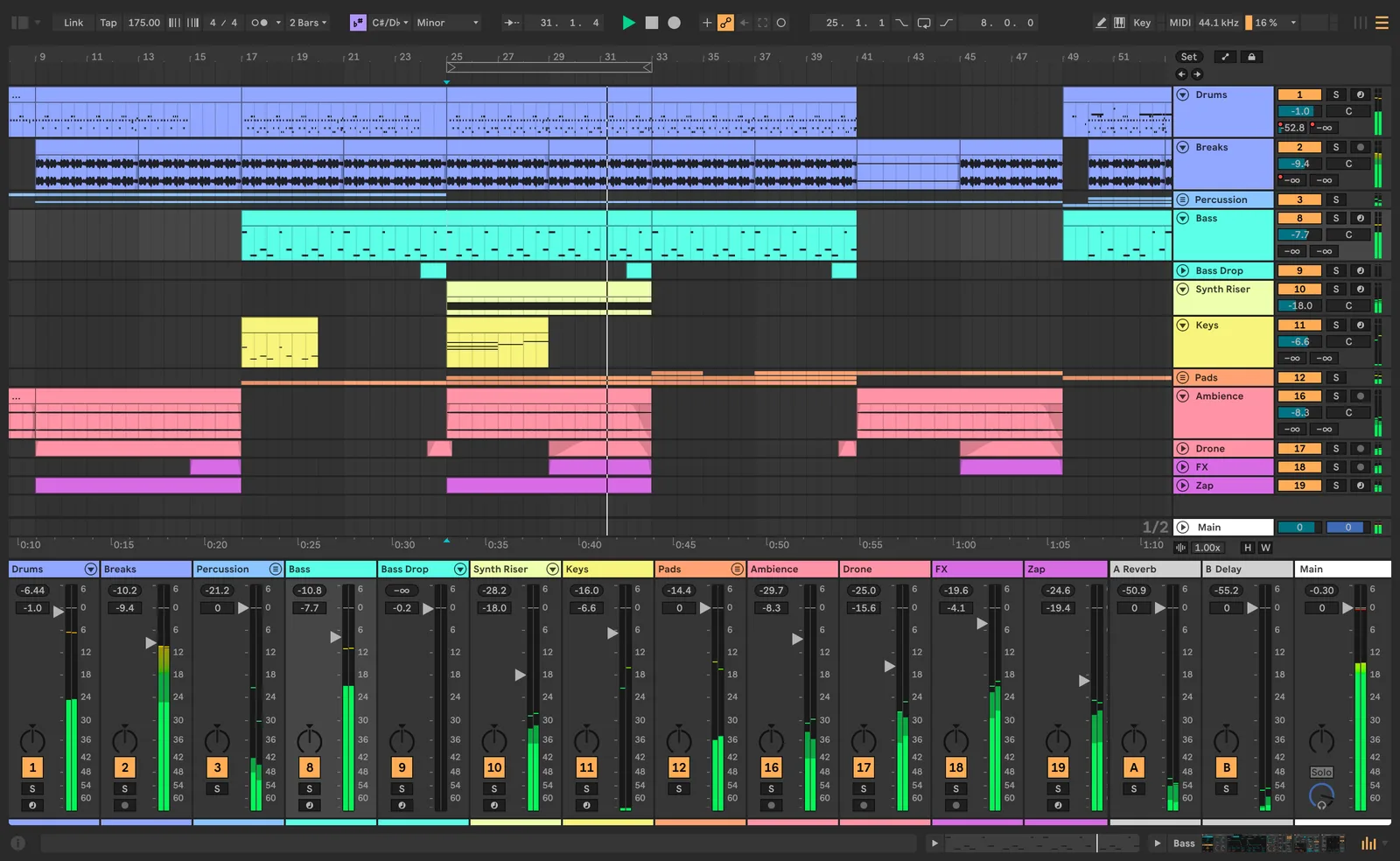
Live 12 brought the mixer into Arrangement View, which is the layout most beat makers end up working in. Screenshot from the Ableton Live 12 press kit, courtesy of Ableton AG.
Ableton's friction is the upgrade ladder. USD 99 feels cheap until the 16 track ceiling hits mid-project, and the jump to Standard is USD 349, with Suite at USD 749 or rent-to-own at USD 31.21 a month. Budget for Standard from the start or accept that Intro is a trial with a receipt.
Logic's friction is the hardware lock. macOS 15.6 and Apple silicon are not negotiable, and Logic Pro for iPad only exists inside the Apple Creator Studio subscription at USD 12.99 a month or USD 129 a year, with a 30 day free trial for new subscribers. No standalone iPad price is published.
- Ableton Suite instruments
- 20
- Ableton Suite audio effects
- 58
- FL Studio All Plugins instruments
- 39
- FL Studio All Plugins effects
- 71
- Logic Pro editions
- One, everything included
FL Studio vs Logic Pro: Pattern Speed Against One Flat Price
If you are on a Mac, this is the pairing most beat makers actually agonise over, and the two answers are genuinely different rather than better and worse.
FL Studio wins on speed to a loop. Lifetime free updates are the other argument, stated by Image-Line as "Every update to your Edition is free, and always has been", and the current release is FL Studio 2026. That means the thing you buy at 19 still gets new features at 29.
Logic wins on everything being present. Logic has a Step Sequencer too, but it is a window you open rather than the view you live in, so the pattern-first habit never quite forms the same way.
FL Studio's friction is the edition maze. Image-Line does not publish per-edition USD prices on its site, only "From $99", and the differences are real: Fruity cannot record audio and ships 23 instruments and 53 effects, Producer adds audio recording, Edison and Newtime at 27 instruments, Signature adds Newtone pitch correction, and only All Plugins includes Harmor, Drumaxx, LuxeVerb and Transmitter. Check current pricing before you buy, and buy one tier above where you think you are.
Logic's friction is that it was not built for pattern loops. Nothing stops you making trap in it, but the timeline keeps asking for a song structure, which is a different mental mode from stacking 8 bar patterns. If you are still at the stage the beginner beat guide covers, that extra structure is either helpful scaffolding or a nag, depending on you.
Where Cubase Fits: Ableton vs Cubase and FL Studio vs Cubase
Cubase shows up in these comparisons because its MIDI editing is deeper than any of the three above, with the most thorough quantise, groove and score handling of the group. Run Ableton vs Cubase or Logic Pro vs Cubase on paper and Cubase usually looks competitive, which is exactly how people end up with it. Steinberg sells it in tiered editions, so read the feature matrix on their site and check current pricing rather than trusting a figure in an article.
For beat makers specifically it is the hardest sell. The sample-flipping and loop-launching features that make FL Studio and Ableton fast are either absent or buried, and the community tutorials you will search for at 2am are overwhelmingly made in the other three.
The friction with Cubase is cultural, not technical. It is a capable program with a smaller beat-making footprint, so you will be translating other people's FL Studio and Ableton tutorials into Cubase terms constantly.
How to Actually Decide
Install the trials and give each one 90 minutes with the same task: one drum pattern, one bassline, one sample chop, at a tempo from the BPM by genre chart. Do not read feature lists during that 90 minutes.
The one you finish the loop in is your DAW. Stock plugin counts matter far less than they look like they do, because the free plugin pool covers most of the gaps on day one.
The last friction is sunk cost. Six months in, every DAW feels like the right one and every other DAW feels broken, which is a sign you learned it rather than evidence you chose correctly. Commit anyway, because fluency in one program beats a working knowledge of three.
Frequently Asked Questions
Is FL Studio or Ableton better for making beats?
FL Studio is faster for programming beats from scratch, because the Channel Rack step sequencer and the piano roll are the first thing you see and the piano roll handles slides, ghost notes and chops better than Ableton's MIDI editor. Ableton Live is better once samples are involved, because warping and Session view let you audition loops against each other in seconds. If you make trap, drill or phonk from a blank pattern, start with FL Studio. If you flip records or play out, start with Ableton.
Is Logic Pro worth it compared to Ableton?
On value, yes. Logic Pro is USD 199.99 once on the App Store and everything is included, while Ableton Live 12 Suite is USD 749 and Live 12 Standard at USD 349 leaves out Max for Live and roughly half of Suite's library. Ableton still wins on warping, Session view and live performance, so the question is whether you need those two features enough to pay the difference.
What is the difference between FL Studio and Logic Pro?
FL Studio is pattern-based. You build short patterns in the Channel Rack and stack them in the Playlist, and mixer routing is something you assign by hand. Logic Pro is timeline-based, with tracks running left to right and channel strips created automatically. Logic also ships far more stock instruments and effects in one purchase, where FL Studio splits them across four editions.
Which DAW is cheapest to get started with?
FL Studio and Ableton both start around USD 99, FL Studio Fruity Edition from $99 with lifetime free updates and Ableton Live 12 Intro at USD 99. Intro caps you at 16 audio and MIDI tracks, and Fruity cannot record audio at all, so both entry tiers run out eventually. Logic Pro has no cheap tier but can be rented inside Apple Creator Studio at USD 12.99 a month with a 30 day free trial for new subscribers.
Do I need to use the same DAW as the producers I listen to?
No. The sound comes from your samples, your drum programming and your mixing, and all three of these finish records at the top of every chart. The only practical reason to match someone else is collaboration, since none of these programs can open another one's project files.
Related Articles
Best Beat Making Software and Programs to Make Beats (2026)
The best beat making software and programs to make beats, from free beat maker apps to FL Studio, Ableton and Logic, plus what you actually need to start.
Best Free VST Plugins for Beat Makers (2026)
We tested the top free VST plugins for beat makers, covering synths, effects, and mixing tools that genuinely compete with paid plugins on sound and workflow.

Louis Raveton
Louis makes Downtempo, Electro-Dub, and beat-driven music under the names Flagada and Monsieur Shwill. He treats his sample drive like a record collection and has been obsessively hunting textures, breaks, and weird synth patches for over a decade. He also composes for Canal+ animation and LVMH installations, which means he has tested tools under real deadline pressure.