
Do This Now
- 1 Find your song's key first. Your 808 root note must match it.
- 2 Set the correct root note inside your sampler, not just on the MIDI notes.
- 3 Keep glides short so slides land on notes that belong to your key.
- 4 Layer two 808s an octave apart instead of stretching one across the range.
- 5 Add saturation so the bass still reads on phone and laptop speakers.
Watch the technique in action, then read on for the details.
An out-of-tune 808 sinks an otherwise great beat. It fights the melody, muddies the low end, and makes the track feel wrong in a way most listeners cannot name but definitely hear. The good news is that tuning is a mechanical process, not a talent. Here are the five steps I run on every beat.
Step 1: Find the Key of Your Song
Everything follows from this one decision, so make it before you write a single bass note.
Play your melody and identify its key. If your melody is in C sharp minor, your 808 needs to be rooted on C sharp. Most DAWs have a scale detection tool, and most melody loops from a decent pack come labeled with the key already.
If your loop is unlabeled, hum the lowest resolving note of the melody and match it against a piano. That note is almost always your root.
Step 2: Find the Sample's True Pitch
Every 808 sample has a pitch baked into it. Some are labeled, many are not, and a few are labeled wrong.
To find the real pitch, solo the 808 and play it against a tuner or a plain sine wave. Slide it up and down in semitones until it matches a known reference note. Now you know what you are working with.
- Reference tone
- Sine wave or tuner plugin
- Test note
- C3 is the common standard
- Watch for
- Labels that disagree with the tuner
- Shortcut
- Buy packs with verified labeling
A pack with clean, correctly labeled 808s skips this step entirely. Tuning stability in the source sample matters more than any plugin you put after it.

Step 3: Set the Root Note in Your Sampler
This is the step beginners skip, and it is the one that actually matters.
The common mistake is leaving the sampler's root note wrong and correcting the pitch with MIDI notes instead. That works for exactly one note and falls apart the moment you play a bassline across an octave.
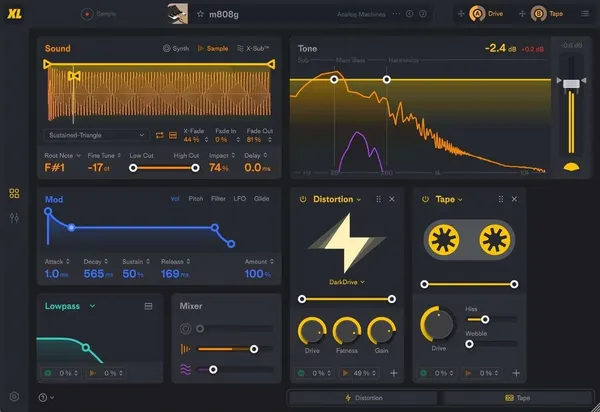
Do this instead. Set the correct root note inside the sampler so middle C plays the true fundamental. Every MIDI note you play after that lands in tune automatically, and your bassline stays correct no matter where you move it.
Step 4: Keep Slides Tight
Slides are central to modern trap and drill, but a sloppy glide loses low end in the transition.
Use a short portamento so the movement is quick and controlled. Long slides drift through pitches that do not belong to your chord, and the sub thins out on the way. Always land on a note that belongs to your key.
- Glide time
- Short, roughly 30-80ms
- Landing note
- Must be a chord tone
- Avoid
- Long drifting slides
- Pitch range
- Stay within about one octave
Step 5: Make It Translate
A bass that knocks on your monitors but vanishes on a phone is not finished.
Add gentle saturation or a distortion layer to the 808. This introduces harmonics an octave or two above the fundamental, and the ear reads those harmonics as bass even when the actual sub is inaudible. It is the single trick that lets an 808 survive the jump from a car system to a phone speaker.
Then check it everywhere. Headphones, laptop speakers, and something with real low end. Consistent translation across systems is the real test, and it is what separates a clean beat from a demo that only works in your room.

Frequently Asked Questions
Why does my 808 sound out of tune even on the right note?
The sample's built-in root note is probably set wrong in your sampler. If the sampler thinks the sample is a C but it was recorded as an F, every note you play lands four semitones off. Find the true pitch first, then set the root correctly.
What key should my 808 be in?
The same key as your melody. If the beat is in C sharp minor, the 808 root is C sharp. The bass should play the root note of whatever chord is sounding at that moment.
Why does my 808 disappear on phone speakers?
Small speakers cannot reproduce sub frequencies at all. Add saturation or distortion to generate harmonics higher up the spectrum. The ear fills in the missing fundamental, so listeners perceive bass that the speaker is not actually producing.
How far can I pitch an 808 before it breaks?
Roughly an octave in either direction before it gets thin or clicky. If you need a wider range than that, layer two 808s tuned to different octaves rather than stretching one sample across everything.
Related Articles

Best 808 Sample Packs & Drum Kits for Beat Makers (2026)
Tested 808 sample packs for tuning stability, sub weight, and slide behavior. These are the best 808 kits for trap, hip-hop, and drill production in 2026.
Best Drum Machine Plugins for Beat Makers (2026)
We tested the top drum machine and 808 plugins for punch, tuning control, and how fast they program a knocking beat without loading a single sample.

Best Trap Sample Packs for Beat Makers (2026)
808 kits, trap hi-hats, and melody loops. We tested the top trap sample packs for sound quality, usability rate, and mix-readiness in real beat sessions.

Marcus Vega
Marcus is a hip-hop producer and drum programmer based in Atlanta. He builds beats for independent rappers, licenses tracks through BeatStars, and has been in the top 500 producers on the platform for three years. He judges every sample pack by one question: does it help him finish a beat faster?